
If you hold a passport from outside the European Union and you are the spouse, registered partner, child or dependent relative of an EU, EEA or Swiss citizen who lives in Spain, you can apply for a tarjeta de residencia de familiar de ciudadano de la Unión. The card is valid for five years, gives you the right to live and work in Spain from day one, and opens the door to permanent residence after that five-year period. This guide walks you through who qualifies, what your EU relative needs to prove, what documents to bring, and what to expect from the timeline.
What the EU family residence card is
The full official name is tarjeta de residencia de familiar de ciudadano de la Unión. In English it usually appears as the EU family residence card or, in a slightly older phrasing, the community family card. It is issued under Royal Decree 240/2007, which is the Spanish transposition of Directive 2004/38/EC on the free movement of EU citizens and their families.
Two things separate it from most other Spanish residence permits.
First, its purpose is to protect the free movement of the EU citizen. When someone from Germany, France or the Netherlands settles in Spain, their spouse or dependants should be able to come with them without complex paperwork. The card exists to make that possible.
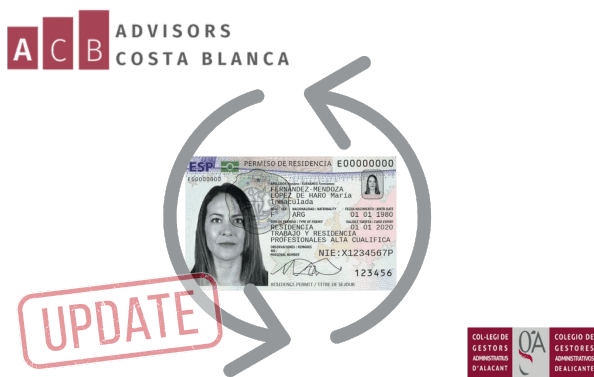
Second, it is issued as a TIE, a plastic card with your photograph and fingerprints, valid for five years and renewable. That is why the card can be visually identical to the one a non-EU worker holds, even though the legal regime and the rights attached to it are broader.
Under this card you can work as an employee, register as self-employed, study, run a business and access public healthcare on the same terms as your EU relative. If you do not yet hold a Spanish NIE, the same appointment issues you one.
EU family card, family of a Spanish citizen or family reunification
Three routes exist for family-based residence in Spain and they get mixed up often. It is worth being clear about which one applies to you.
The EU family card is the route this page describes. Your relative is an EU, EEA or Swiss national who is not Spanish. Legal basis is Royal Decree 240/2007. Requirements focus on proving the family tie and that the EU relative exercises free movement rights (works, studies or has resources).
The family of a Spanish citizen route uses the same royal decree, extended to cover family members of Spaniards. The rules are almost identical but with two practical differences. The Spanish sponsor does not need to prove income or health cover for themselves the way an EU sponsor does, and certain documentary requirements are lighter.
Family reunification (reagrupación familiar) is a completely different route, governed by the general immigration law rather than the community regime. It applies when the sponsor is a non-EU resident in Spain, for instance a Moroccan or Colombian resident bringing over a family member from outside the EU. The financial requirements are stricter, the timeline is longer and it does not lead automatically to full working rights on day one.
| Route | Sponsor | Legal basis | Key financial test |
|---|---|---|---|
| EU family card | EU, EEA or Swiss citizen (not Spanish) | Royal Decree 240/2007 | Sponsor must exercise free movement rights |
| Family of a Spanish citizen | Spanish national | Royal Decree 240/2007 (extended) | Lighter requirements for sponsor |
| Family reunification | Non-EU resident in Spain | General immigration law | Higher income threshold and one-year prior residence |
If your relative is Dutch, German or Swedish, you are on the right page. If your relative is Spanish, the procedure is very close but not identical. If your relative is non-EU with residency in Spain, you belong on the family reunification route. For a broader overview of the residency options available in Spain, see our guide to Spanish residency.
Who qualifies as a family member
The regulation lists specific relatives who can apply and specific relatives who can apply if they can prove dependence.
Spouse of an EU citizen
Marriage in any country, as long as the marriage is legally valid where it was celebrated and the certificate can be legalised and translated into Spanish. The marriage cannot be one of convenience, and the administration reviews the timing and circumstances if there are doubts.
Registered civil partner
A registered partnership recognised as equivalent to marriage in the country of registration. Not every civil partnership qualifies, because Spain recognises the ones that are officially registered in a public registry equivalent to a civil registry.
Unregistered partner with proven cohabitation
A stable partner who is not married or registered can qualify by proving cohabitation for a continuous period of at least one year. Where the couple has a shared child, the one-year requirement does not apply. Cohabitation is proven with joint padrón, rental contracts in both names, bills, bank statements and any other paperwork that shows a shared life.
Descendants under 21 and older dependent descendants
Children, grandchildren and, in some cases, great-grandchildren of the EU citizen or of their spouse or partner. Under 21 they qualify automatically. Over 21, they need to prove financial dependence on the EU citizen (regular financial support and no independent income of their own).
Ascendants who are financially dependent
Parents, grandparents and other direct ascendants of the EU citizen or of their spouse or partner, when they can prove financial dependence. Dependence is usually shown through regular money transfers, joint utility bills or a formal declaration confirming that the EU relative supports them.
Other dependent relatives in exceptional circumstances
The regulation extends the right in exceptional cases to relatives who are members of the same household, who require personal care from the EU citizen because of a serious health reason, or who are in similar situations of dependence. These cases are more paperwork-heavy and often require additional evidence.
What the EU citizen sponsor must prove
The card is granted because the EU citizen is exercising their right of free movement. That means the sponsor has to fit into one of the four profiles below and provide the corresponding proof. If the sponsor does not yet hold a CUE, the two applications can be prepared together.
Employed sponsors
An employment contract with a Spanish employer and their Social Security registration. Nothing more is required in terms of income, because a legitimate contract with contributions covers both the economic condition and the health cover.
Self-employed sponsors
RETA registration or a Modelo 036/037 filing that confirms the activity has been declared to the Spanish tax office. Recent Social Security payments help complete the picture.
Student sponsors
Enrolment certificate from a recognised Spanish institution, health insurance and a declaration of sufficient resources for the whole family.
Non-working sponsors with sufficient means
The most paperwork-heavy of the four profiles. The sponsor demonstrates two things. First, income or savings enough to support the whole family, using the IPREM as a reference (in 2026 the IPREM stands at around 600 euros a month, or 7,200 euros a year across twelve payments). The commonly accepted threshold is 100% of annual IPREM for the sponsor plus 25% of IPREM for each additional family member, though the final figure is confirmed at the moment of preparing the file because the IPREM is updated in the yearly budget law. Second, private health insurance with full cover in Spain and no co-payments, or an equivalent public system such as the S1 form when that applies.
Documents you need to submit
- Form EX-19 filled in and signed (two copies).
- Valid passport of the applicant, plus a photocopy of every used page.
- Identity document of the EU citizen (DNI or passport), plus a photocopy.
- Proof of the EU citizen's residence in Spain (CUE, or the CUE application in progress).
- Proof of the family tie. A marriage certificate for spouses, a partnership certificate for registered partners, birth certificates for children, or a package of cohabitation evidence for unregistered partners.
- Recent empadronamiento certificate showing shared address, where applicable (see our guide on how to get a padrón for the town hall process).
- Proof of the sponsor's profile, as described in the previous section.
- Comprehensive private health insurance for the applicant when the sponsor does not work.
- Three recent passport-style photographs.
- Payment receipt for tax form 790 code 012.
Documents issued outside the European Union have to be legalised (apostille under the Hague Convention when the issuing country is a signatory, consular legalisation otherwise) and translated into Spanish by a traductor jurado. Documents issued inside the EU are often exempt under Regulation 2016/1191, though marriage and birth certificates should ideally be requested in multilingual format from the outset.
How the application works
There are two entry points, and which one applies to you depends on where you are physically located when the process begins.
When you are already in Spain
You enter Spain as a tourist (or as your passport allows) and apply for the card at the Oficina de Extranjería in the province where you and your EU relative live. The application window is ninety days from your date of entry. During that ninety-day window you can present the file even without a specific visa in your passport.
Once the file is submitted, you receive a stamped receipt. That receipt already permits you to stay in Spain while the application is being resolved, and in most cases it lets you register with Social Security to start working.
When you are still abroad
Your EU relative applies for a visado de residencia para familiar de ciudadano de la Unión on your behalf, or you apply directly at the Spanish consulate in your country of residence. The visa is free of charge, has priority processing and is granted specifically to accompany or join the EU citizen. Once you enter Spain with that visa, you complete the process by attending the appointment at the Oficina de Extranjería to have the card issued and your fingerprints taken.
Timeline and what happens after you apply
Resolution takes up to three months by law, though the practical wait at the Alicante Oficina de Extranjería is often shorter when the file is complete. Once the file is approved, you receive a favourable resolution letter. You then book a cita para toma de huella (our TIE card page walks through the fingerprinting step), attend with your fingerprints and photograph, and collect the physical TIE card a few weeks later.
Between the initial submission and the physical card in your hand, the receipt you were given at submission is what proves your legal stay and, when relevant, your right to work.
Fees
Two fees apply. The tax for the family card itself is paid through Modelo 790 código 012, at approximately 12 euros in 2026. A separate fee applies to the physical TIE issuance and is paid through the same Modelo 790 código 012 for the fingerprinting appointment, at around 17 euros. Both figures are set by the Ministry and can be updated when their fee schedule changes, so we confirm the exact amounts at the moment of preparing your file.
Renewal, permanent residence and long absences
The initial card is valid for five years. What happens at the end of that period depends on your circumstances.
Renewal after five years
You can renew before the five-year mark if you are staying in the same family situation and the EU relative continues to reside in Spain. The renewal application is filed online through the Sede Electrónica and, if approved, extends your rights on the same terms as the initial card.
Applying for permanent residence
At the five-year mark, if you have lived in Spain legally and continuously with your EU relative, you gain the right to apply for permanent residence as a family member. This is called residencia permanente de familiar de ciudadano de la Unión. Once granted, you no longer depend on the EU relative to maintain your residence rights, and the card is renewed on a longer schedule.
If you divorce or your EU partner passes away
The regulation protects you in these situations, though with conditions.
In case of death of the EU relative, you keep your card if you had been residing in Spain with them for at least one year before their death. Children of both partners keep their rights as long as they are enrolled in education in Spain.
In case of divorce or termination of the partnership, you keep your card if the marriage or partnership had lasted at least three years, at least one of which was in Spain. Additional protections apply where there are children, when the divorce follows domestic violence, or when specific hardship circumstances are recognised.
Because the paperwork varies by case, we do not treat this section as a substitute for reviewing your specific file.
Frequently asked questions
My EU partner does not yet have a CUE. Can we still apply?
You can prepare both files together and present them either at the same time or in short succession. The administration will check that your EU relative is genuinely exercising their free movement rights, so what matters is that the sponsor's file is complete, not that they hold the green certificate before yours.
Does an unregistered relationship qualify?
Yes, when you can prove continuous cohabitation of at least one year, or shorter if you share a child. The evidence has to be documentary. Joint padrón registration, tenancy agreements in both names, joint bank accounts or bills with matching addresses over a sustained period all count.
Can I apply as a tourist within my ninety-day Schengen window?
Yes. The regulation is clear that you can present the application inside Spain during the ninety days that follow your entry. You do not need a residence visa to file. What you cannot do is exceed the ninety days without a decision on your file, so the earlier the application goes in, the smoother the transition.
Do I need a job offer or a minimum salary?
No. The financial requirement rests on the EU relative, not on you. If the sponsor works, is self-employed, is a student with resources or has sufficient means and health insurance, the requirement is met regardless of your own employment history.
My marriage was performed abroad. Is that a problem?
It is not a problem in itself. The marriage has to be recognised in the country where it took place and the certificate has to reach Spain properly legalised and translated. Marriages recorded on the Spanish consulate registry abroad simplify the paperwork.
Can I work in Spain while the application is being processed?
The stamped receipt you get at submission normally allows you to start working, register with Social Security and sign a contract. In practice, some employers ask for the physical card before hiring, so we advise clients to keep the receipt visible in any employment conversation and, when needed, add a short explanation from us confirming the legal position.
What happens if my application is refused?
You have the right to appeal within one month of notification. Refusals usually stem from a specific weakness in the file, most often a poorly evidenced family tie, an incomplete financial file for the sponsor, or health insurance that does not meet the criteria. In most cases the issue can be corrected and the appeal succeeds, but the earlier the weakness is spotted the smoother the process.
Can I sponsor my parents from outside the EU?
Only if you can prove they are financially dependent on the EU relative, not on you. Regular money transfers, joint utility bills or a formal declaration are the usual ways to prove dependence, and the receiving Oficina de Extranjería is careful about the evidence.
Does this card lead to Spanish nationality?
It counts as legal residence for the purposes of Spanish nationality by residence. The standard requirement is ten years of legal residence for most nationals, reduced to two years for citizens of Ibero-American countries, Andorra, the Philippines, Equatorial Guinea, Portugal and Sephardic Jews. The years spent under the EU family card count towards those totals.
What if my EU partner and I later separate or divorce?
You keep your rights when the couple had been legally married or registered for at least three years and at least one year was spent in Spain, or in the special protection scenarios described earlier. If those conditions are not met, the right to reside as an EU family member ends and you would need to convert to a general immigration route, which is possible in many cases but requires a separate procedure.